Monday, 14 February 2011

DONALD URQUHART'S THE BEAUTIFUL BEND PRESENTS 'I GOT DRESSED DRUNK' AT CENTRAL STATION


friendly Central Station bar staff


Vienna Vermont, Princess Julia, Anne McCloy


'The Beautiful Bend', Donald Urquhart's occasional club re-surfaced last Saturday at Central Station in Kings Cross, London.
Who knows when the next one will be? The theme, "I GOT DRESSED DRUNK" does exactly what it says on the bottle. Entry is strictly £5, but you can expect to take plenty of posters away with you, and no doubt the odd bruise and bizarre memory...

http://www.centralstation.co.uk/

Friday, 11 February 2011

JOE VILLABLANCA, GREAT 1998 VIDEOS: 'GRAN SANTIAGO' AND 'QUIERO SER EL DIRECTOR MAS JOVEN DE LA HISTORIA DEL MUSEO NACIONAL DE BELLAS ARTES'


Joe Villablanca, 'Gran Santiago', 1998


Joe Villablanca, 'Quiero Ser El Director Mas Joven de la Historia del Museo Nacional de Bellas Artes', 1998

about Joe Villablanca's 'Gran Santiago' by Michele Faguet
in Michèle Faguet, 'Marginally successful: A brief account of two artist-run spaces' in On Cultural Influence: Collected Papers from apexart International Conferences 1999-2006', apexart, New York, 2006

"In it the artist places a call to a local talk-show program which aired in the early morning hours and which presumably nobody watched. That show, like the video, is called Gran Santiago and is hosted by two middle-aged AM-radio personalities. Holding the camera in one hand (the video-tape image shows the face of one of the hosts looking out from the television into the eyes of his caller), Villablanca talks to his silent public about the role of Galería Chilena in relation to the emergence in Chile of a new artistic scene. The hosts nod patiently, attempting to politely but unsuccessfully end the call, as the caller is both wide-awake and insistent. It is perhaps this video that most eloquently articulates the fate of a project which already had knowledge and acceptance of (and perhaps desire for) its ultimate failure built into it from its very inception: an artist alone and awake in his room at 5 o'clock in the morning, his words falling on deaf ears, conscious of the indifference of those who only pretend to listen, and yet always just a little bit hopeful. All this ambiguity had been incorporated into the project from the very beginning. A constant parody of itself, Galería Chilena simply stated the obvious: that the creation of an informed group of collectors of contemporary art in Chile was simply not possible at this stage of the country’s development. But in making explicit this failure, Galería Chilena was effectively articulating a set of negative truths about its immediate context against the spastic, unwarranted optimism that had gripped Chile during the first phase of the post-dictatorship, as well as about the way in which the art world must constantly prostitute itself to publicists and buyers in order to achieve the visibility necessary to be socially relevant. Even their notably effective milking of the local media machine was not enough to gain them international recognition; this is because contemporary Chilean art is strongly tied to a localist paradigm which utilizes references not easily comprehensible to the outside world, directly interfering with its ability to penetrate international art circuits."

Tuesday, 8 February 2011

'MARIHUANO DRAWINGS' BY RAIMOND CHAVES


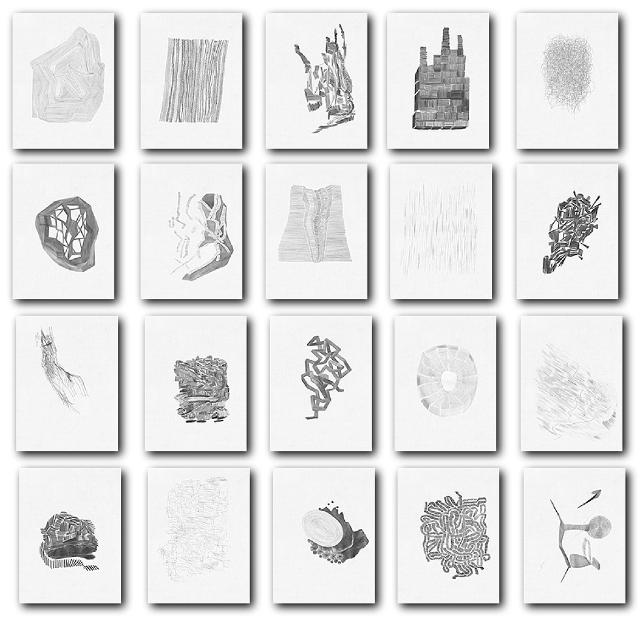
Raimond Chaves, 'Marihuano Drawings', drawings done trying to remember how one drew under the effects of marihuana.
(scroll for spanish version)

Marihuano Drawings
Raimond Chaves
A text not yet written about these drawings should tell a series of seemingly unrelated issues. It would be necessary to describe in it, things that happened long time ago and to refer to some incidents of a personal nature. It might be necessary to venture some kind of relationship between these drawings, done like in the air, and the floating perception that today we have of time and space and the sensation that history became fleeting and elusive. It would not hurt either to establish some links with the experiences that some writers like Benjamin, and artists such as and Michaux developed once with hashish and mescaline. And then we would have to tell it all in a way to disable the frivolity and the prejudices that the name might carry with it.

A text not yet written about these drawings would tell that in 1997 with Carolina Caycedo after strolling under the rain and smoking lots of marijuana we drew on large sheets of paper for no other reason than to enjoy and celebrate that we were alive and happy. We drew on the floor, on the bed or over the tables. The pictures came out from anything, and they did by one, two, three and four hands. We cut and glued no matter what. And around us, alone or together, the marihuano drawings grew and accumulated.

“A poster of a singer retouched up insolently, identikits on top of the paper whose tears descended to the bottom of the sheet. Explosions, leaks, swirls, squiggles, airtight strokes so intimate. Everything so intense, everything so arbitrary.”

A text not yet written about these drawings would point out how in 1997 there were a number of issues that thirteen years later would allow them to be read as a significant coincidence.

In 1997, for me, time ceased to exist when I encountered the “undo” function, that possibility of computer writing that made it possible for time to maintain intact its carcass made of measures, terms and ready-made phrases, but that made the relationship between their more conventional orders, that is, between past, present and future, fade away.

In 1997 all this happened in a place where greed for land caused, and still causes, a constant toll of death and silence; in a place where one worked, and still works, without pause in the chemical process capable of compressing the perception of time, and where, to round off, the radio in the buses was determined in turning the future, and hence history, in the chained reiteration of the same old songs.

A text not yet written about these drawings would tell that in 1997 when the "undo" function just started to adjust everything so quietly, I managed to live a great epiphany of softened perception thanks to marijuana.

“And if the grass softens the time, cinema parks it and reading permits the coexistence of parallel times, what the "undo" function achieves is to overturn it, confusing and stunning their orders with only the touch of a finger.”

A text not yet written about these drawings would wonder if today, thirteen years later, one can do some marihuano drawings again. But this time without the help of said substance, while maintaining that sense of freedom and the possibility to break constantly one’s own path. That way of drawing with and against yourself at the same time. With the desire of not being faithful to anything or anyone. Pretending not to say anything and wanting to tell everything.

A text not yet written about these drawings would wonder if the only drawings of which one is able - like the erection of the hanged man or the flailings of a drowned man - are no other thing than prisoner drawings. Drawings condemned not to be other thing but the repetition of the same ways as always, the same tricks, the mere confirmation of what is known. The impossibility of escape.

A text not yet written about these drawings would tell how they have been made between these two poles, coming and going from one extreme to another.

Between Lima and Bogota in November 2010.

*****

Los Dibujos Marihuanos
Raimond Chaves

Un texto aún no escrito a propósito de estos dibujos debería contar de una serie de asuntos aparentemente inconexos. Sería necesario relatar en él cosas sucedidas hace mucho tiempo y referir algunas peripecias de índole personal. Quizás fuera necesario aventurar alguna relación entre estos dibujos, hechos como en el aire, y la percepción flotante que hoy día tenemos del tiempo y el espacio y esa sensación de que la historia se volvió fugaz y esquiva. No estaría de más tampoco establecer algún tipo de vínculo con las experiencias que ciertos escritores como Benjamin y artistas como Michaux desarrollaron en su momento con el hachís y la mescalina. Y de pronto habría que contarlo todo ello de manera que quedaran desactivadas la frivolidad y los prejuicios que el nombre pueda acarrear consigo.

Un texto aún no escrito a propósito de estos dibujos contaría que en 1997 con Carolina Caycedo tras callejear bajo la lluvia y fumar harta marihuana dibujábamos en grandes pliegos de papel sin otro motivo que disfrutar y celebrar que estábamos vivos y contentos. Que dibujábamos en el piso, sobre la cama o sobre las mesas. Que los dibujos salían a partir de cualquier cosa y lo hacían a una, dos, tres y a cuatro manos. Que cortábamos y pegábamos no importaba qué. Que a solas o juntos los dibujos marihuanos crecían y se amontonaban.

Un afiche de una cantante retocado insolentemente, unos retratos seriados encabezando el papel cuyas lágrimas descendían hasta el borde inferior del pliego. Explosiones, fugas, remolinos, garabatos, trazos herméticos de tan íntimos, todo arbitrario de tan vehemente.

Un texto aún no escrito a propósito de estos dibujos señalaría cómo en 1997 se dieron una serie de asuntos que trece años más tarde permiten ser leídos como una significativa coincidencia.

En 1997, para mi, el tiempo dejó de existir al encontrarme con la función “deshacer”, esa posibilidad de la escritura en computador que hizo que el tiempo mantuviese intacta su carcasa hecha de medidas, términos y frases hechas, pero que la relación entre sus órdenes más convencionales, esto es entre pasado, presente y futuro, se esfumara.

En 1997 eso se dio en un lugar, donde la ambición por la tierra provocaba -y provoca- una constante cuota de muerte y silencio; donde también se trabajaba -y se trabaja- sin pausa en el proceso químico capaz de comprimir la percepción del tiempo y en donde, para redondear, la radio en los buses se empeñaba en convertir el devenir, y por ende la historia, en la reiteración encadenada de las mismas y añejas canciones.

Un texto aún no escrito a propósito de estos dibujos contaría que en 1997 cuando la función “deshacer” recién empezaba a reglarlo todo de manera callada, alcancé a vivir una suerte de gran epifanía de la percepción reblandecida gracias a la marihuana.

Y si la yerba ablanda el tiempo, el cine lo aparca y la lectura permite la coexistencia de tiempos paralelos, la función “deshacer” lo que logra es anularlo a punta de confundir y marear sus órdenes con sólo mover un dedo.

Un texto aún no escrito a propósito de estos dibujos se preguntaría si hoy, trece años después, es posible volver a hacer unos dibujos marihuanos -esta vez sin la ayuda de dicha sustancia- pero manteniendo ese sentido de libertad, esa posibilidad de quiebre constante con la propia ruta, ese dibujar con y contra uno mismo a la vez. Con el anhelo de no serle fieles a nada ni nadie. No queriendo decir nada para contarlo todo.

Un texto aún no escrito a propósito de estos dibujos se preguntaría si es que de los únicos dibujos de los que uno es capaz, como sucede con la erección del ahorcado, o los manotazos del ahogado no son más que dibujos de prisionero. Dibujos condenados a no ser otra cosa que reiteración de las mismas maneras de siempre, de las mismas mañas, mera confirmación de lo sabido. Imposibilidad de fuga.

Un texto aún no escrito a propósito de estos dibujos contaría como estos han sido hechos entre estos dos polos, yendo y viniendo de un extremo a otro.

Entre Lima y Bogotá a noviembre de 2010.

http://www.puiqui.com

Monday, 7 February 2011

'CALI: FALLAS DE ORIGEN', CURATED BY JUAN SEBASTIAN RAMIREZ AT LA CENTRAL, BOGOTA


Wilson Diaz, 'Fallas de Origen', 1997


Wilson Diaz, 'Cali Coca Gardens', 2003


Leonardo Herrera, 'El Origen de las Cosas' polaroids, 1998 (right wall)


Leonardo Herrera, 'Signature of Rodriguez Orejuela', 2003; and Jose Horacio Martinez, 'The Bodyguard' watercolours, 2010


Jose Horacio Martinez, 'The Bodyguard' video , 2010 and Margarita Garcia, 'Cali Cartels', 2010


Wilson Diaz, 'Cali Coca Gardens', 2003


Wilson Diaz, 'Fallas de Origen', 1997


Jose Horacio Martinez, 'The Bodyguard' watercolours, 2010


Leonardo Herrera, 'Signature of Rodriguez Orejuela', 2003


Leonardo Herrera, 'El Origen de las Cosas' polaroids, 1998


gallerists Katherine Hernandez and Beatriz Lopez with exhibition curator Juan Sebastian Ramirez


artist Wilson Diaz next to his work


CALI: FALLAS DE ORIGEN
'Cali: Fallas de Origen' is an exhibition that looks at the narco problem(1) within the context of the city of Cali, with works by Wilson Díaz, José Horacio Martinez, Leonardo Herrera and Margarita García.

During the 70s the drug trafficking "business"(2) started to make its appearance in Cali. Already in the 80s it had pervaded all aspects of Cali's society, and the city became one of the world’s epicentres for drug trafficking(3). After the demise of the Cali Cartel(4) that used to concentrate most of the trade, far from disappearing the activity atomized into hundreds of smaller illegal groups with lower visibility. While during the 70s one could hear rumours about the recent existence of drug trafficking in the city, during the mid-80s one could consider drug trafficking as being omnipresent; nowadays, the phenomenon persists atmospherically.

Both, the instant money from drugs and the violence inflicted by the Mafia changed the city for good with dramatic results. The architecture of Cali, went from the 50s unfinished Modernism, to the Miami style going through the narco deco,and finally landed on the syncretic narco-architecture that currently prevails in the city. The slang to refer to narcos went from the picaresque mágico(5) to the derogatory – but contextual – traqueto(6), to the current common use of narco as a prefix that seems to be applicable to any sort of word(7).

Notes:
1. The category 'narco problem' includes the stages of production, processing, trafficking and consumptio; from Santiago Rueda Fajardo 'Una línea de polvo: Arte y drogas en Colombia', Alcadía Mayor de Bogotá, Bogotá, 2009
2. During the early 70s, before the consequences of drug trafficking could be anticipated, drug trafficking was socially perceived as a commercial activity rather than a crime.
3. During the 80s, the Cali cartel along with the Medellin cartel were responsible for the 90% of drug smuggling in the USA according to the DEA.
4. The capture and extradition of the Rodríguez Orejuela brothers and the arrest of Chepe Santacruz, during the presidential period of Ernesto Samper, was the beginning of the end of the Cali cartel.
5. The term mágico suggested the amazing ease the racketeers had to generate money.
6. The word traqueto, synonym of drug baron originates from the onomatopoeia of a machine gun shooting, tra-ca-ta.
7. Some examples of the use of narco as prefix in Colombia are narco-toyota, narco-chalet, narco-burbuja, narco-politica, narco-economía, narco-terrorismo, etc...


http://www.lacentral.com.co

Wednesday, 2 February 2011

GIACOMO BALLA, 'IL GIARDINO FUTURISTA' AND 'FUTURIST SUIT', 1913-1930


Giacomo Balla, 'Il Giardino Futurista', 1916-1930
reconstruction at Nordenhake gallery in 2003


'Compenetrazione iridescente - Eucalyptus', 1914


Giacomo Balla, 'Il Giardino Futurista', 1930


Giacomo Balla, 'Futurist Suit', 1913-1918


The Futurist Reconstruction of the Universe
by Giacomo Balla and Fortunato Depero
March 11, 1915

We Futurists, Balla and Depero, seek to realize this total fusion in order to reconstruct the universe making it more joyful, in other words by a complete re-creation. We will give skeleton and flesh to the invisible, the impalpable, the imponderable and the imperceptible. We will find abstract equivalents for every form and element in the universe, and then we will combine them according to the caprice of our inspiration, creating plastic complexes which we will set in motion. Balla initially studied the speed of automobiles, thus discovering the laws and essential line-forces of speed. After more than twenty exploratory paintings, he understood that the flat plane of the canvas prevented him from reproducing the dynamic volume of speed in depth. Balla felt the need to construct, with strands of wire, cardboard sheets, fabrics, tissue paper, etc., the first dynamic plastic complex.

1. Abstract.
2. Dynamic. Relative movement (cinematographic) + absolute movement.
3. Extremely transparent. Because of the speed and volatility of the plastic complex, which must appear and disappear, light and impalpable.
4. Brightly colored and extremely luminous (using internal lights).
5. Autonomous, that is, resembling itself alone.
6. Transformable.
7. Dramatic.
8. Volatile.
9. Odorous.
10. Noise-creating. Simultaneous plastic noisiness with plastic expression.
11. Explosive, elements appear and disappear simultaneously with a bang.

The free-wordist Marinetti, when we showed him our first plastic complexes, said enthusiastically: “Before us, art consisted of memory, anguished re-evocation of a lost Object (happiness, love, landscape), and therefore nostalgia, immobility, pain, distance. With Futurism art has become action-art, that is, energy of will, optimism, aggression, possession, penetration, joy, brutal reality in art. (e.g. onomatopoeia; e.g. intonarumori = motors), geometric splendor of forces, forward projection. Art becomes Presence, a new Object, the new reality created with the abstract elements of the universe. The hands of the traditionalist artist ached for the lost Object; our hands longed for a new object to create. That is why the new object (plastic complex) appears miraculously in yours.”

MATERIAL CONSTRUCTION OF THE PLASTIC COMPLEX
Necessary means: Colored strands of wire, cotton, wool, silk, of every thickness. Colored glass, tissue paper, celluloid, wire netting, every sort of transparent and bright material. Fabrics, mirrors, sheets of metal, colored tin-foil, every sort of gaudy material. Mechanical and electrical devices; musical and noise-making elements, chemically luminous liquids of variable colors; springs, levers, tubes, etc. With these means we will construct:
Rotations:
1. Plastic complexes rotating on a pivot (horizontal, vertical, oblique).
2. Plastic complexes rotating on several pivots:
a. in the same direction but with varying speeds;
b. in opposite directions;
c. in the same and opposite directions.

Decompositions:
3. Plastic complexes which break up:
a. into volumes;
b. into layers;
c. in successive transformations (cones, pyramids, spheres, etc.).
4. Plastic complexes which break up, talk, make noises and play music simultaneously.

Decomposition, Transformation → Form + Expansion → Onomatopoeias, Sounds, Noises.

Miracle Magic:
5. Plastic complexes which appear and disappear:
a. slowly;
b. by repeated jerks (in scales);
c. with unexpected explosions. Pyrotechnics—Water—Fire—Smoke.

THE DISCOVERY—INFINITE SYSTEMATIC INVENTION
Using complex, constructive, noise-producing abstraction, in short, the Futurist style. Every action developed in space, every emotion felt, will represent for us a possible discovery. Examples: Watching an aeroplane swiftly climbing while a band played in the square, we had the idea of plasticmotor- noise music in space and the launching of aerial concerts above the city. The need to keep changing our environment, together with sport, led us to the idea of transformable clothes (mechanical trimmings, surprises, tricks, disappearance of individuals). The simultaneity of speed and noises inspired the rotoplastic noise fountain. Tearing up a book and throwing it down into a courtyard resulted in phono-moto-plastic advertisement and pyrotechnic-plastic-abstract contests. A spring garden blown by the wind led to the concept of the Magical transformable motor-noise flower. — Clouds flying in a storm suggested buildings in noise-ist transformable style.

THE FUTURIST TOY
In games and toys, as in all traditionalist manifestations, there is nothing but grotesque imitation, timidity (little trains, prams, puppets), immobile objects, stupid caricatures of domestic objects, antigymnastic and monotonous, which can only cretinize and depress a child. With plastic complexes we will construct toys which will accustom the child:
1. to completely spontaneous laughter (through absurdly comical tricks);
2. to maximum elasticity (without resorting to thrown projectiles, whip cracking, pin pricks, etc.);
3. to imaginative impulses (by using fantastic toys to be studied under a magnifying glass, small boxes to be opened at night containing pyrotechnic marvels, transforming devices, etc.)
4. to the continual exercise and sharpening of his sensitivity (in the unbounded realms of acute and exciting noises, smells and colors)
5. to physical courage, to fighting and to war (with gigantic, dangerous and aggressive toys that will work outdoors).
The Futurist toy will be very useful to adults too, keeping them young, agile, jubilant, spontaneous, ready for anything, untiring, instinctive and intuitive.

THE ARTIFICIAL LANDSCAPE
By developing the first synthesis of the speed of an automobile, Balla created the first plastic ensemble. This revealed an abstract landscape composed of cones, pyramids, polyhedrons, and the spiral of mountains, rivers, lights and shadows. Evidently a profound analogy exists between the essential line-forces of speed and the essential line-forces of a landscape. We have reached the deepest essence of the universe and have mastered the elements. We shall thus be able to construct.

THE METALLIC ANIMAL
Fusion of art + science. Chemistry, physics, continuous and unexpected pyrotechnics all incorporated into a new creature, a creature that will speak, shout and dance automatically. We Futurists, Balla and Depero, will construct millions of metallic animals for the greatest war (conflagration of all the creative energies of Europe, Asia, Africa and America, which will undoubtedly follow the current marvelous little human conflagration). The inventions contained in this manifesto are absolute creations, generated entirely by Italian Futurism. No artist in France, Russia, England or Germany anticipated us by inventing anything similar or analogous. Only the Italian genius, which is the most constructive and architectural, could invent the abstract plastic ensemble. With this Futurism has determined its style, which will inevitably dominate the sensibility of many centuries to come.

*****

Futurist Manifesto of Men's Clothing
by Giacomo Balla
Manuscript. 1913

We Futurists, in those brief gaps between our great struggles for renewal, have spent the time discussing, as is our wont, very many subjects. For quite some time now we have been convinced that today's clothes, while they may be somewhat simplified to suit certain modern requirements, are still atrociously passéist.

WE MUST DESTROY ALL PASSÉIST CLOTHES, and everything about them which is tight-fitting, colourless, funereal, decadent, boring and unhygienic. As far as materials are concerned, we must abolish: wishywashy, pretty-pretty, gloomy, and neutral colours, along with patterns composed of lines, checks and spots. In cut and design: the abolition of static lines, all uniformities such as ridiculous turn-ups, vents, etc. Let us finish with the humiliating and hypocritical custom of wearing mourning. Our crowded streets, our theatres and cafés are all imbued with a depressingly funereal tonality, because clothes are made only to reflect the gloomy and dismal moods of today's passéists.

WE MUST INVENT FUTURIST CLOTHES, hap-hap-hap-hap-happy clothes, daring clothes with brilliant colours and dynamic lines. They must be simple, and above all they must be made to last for a short time only in order to encourage industrial activity and to provide constant and novel enjoyment for our bodies. USE materials with forceful MUSCULAR colours - the reddest of reds, the most purple of purples, the greenest of greens, intense yellows, orange, vermilion - and SKELETON tones of white, grey and black. And we must invent dynamic designs to go with them and express them in equally dynamic shapes: triangles, cones, spirals, ellipses, circles, etc. The cut must incorporate dynamic and asymmetrical lines, with the left-hand sleeve and left side of a jacket in circles and the right in squares. And the same for waistcoats, stockings, topcoats, etc. The consequent merry dazzle produced by our clothes in the noisy streets, which we shall have transformed with our FUTURIST architecture, will mean that everything will begin to sparkle like the glorious prism of a jeweler’s gigantic glass-front, and all around us we shall find acrobatic blocks of colours set out like the following wordshapes:

Coffeecomhou Rosegreebastocap transpomotocar legcutshop blueblackwhitehouses aerocigarend skyroofliftyellight anomoviesphot barbebbenpurp.

Human beings, until now, have dressed (more or less) in black mourning.
We are fighting against:
(a) the timidity and symmetry of colours, colours which are arranged in wishy-washy patterns of idiotic spots and stripes;
(b) all forms of lifeless attire which make man feel tired, depressed, miserable and sad, and which restrict movement producing a triste wanness;
(c) so-called 'good taste' and harmony, which weaken the soul and take the spring out of the step.

We want Futurist clothes to be comfortable and practical
Dynamic
Aggressive
Shocking
Energetic
Violent
Flying (i.e. giving the idea of flying, rising and running)
Peppy
Joyful
Illuminating (in order to have light even in the rain)
Phosphorescent
Lit by electric lamps.

Pattern changes should be available by pneumatic dispatch; in this way anyone may change his clothes according to the needs of mood. Available modifications will include:
Loving
Arrogant
Persuasive
Diplomatic
Unitonal
Multitonal
Shaded
Polychrome
Perfumed.

As a result we shall have the necessary variety of clothes, even if the people of a given city lack the imagination themselves. The happiness of our Futurist clothes will help to spread the kind of good humour aimed at by my great friend PaIazzeschi in his manifesto against sadness.

Shortly to appear: a Futurist manifesto on Women's Clothing

images of the reconstruction of Balla's futurist garden from
http://www.nordenhake.com/php/exhibition.php?id=28&year=2003

I am thankful to artist Ludovica Giosca for introducing me to Balla's work.

Tuesday, 1 February 2011

TWO LITHUANIANS AND A PALESTINIAN WALK INTO A ROOM FULL OF MEXICANS. 7 OBSERVATIONS ON THE EXHIBITION 'INTO THE BELLY OF A DOVE'


Two Lithuanians and a Palestinian Walk into a Room Full of Mexicans. 7 Observations

1.
Would the generalization, sometimes exhibitions work like a cartoon, sound more like phlegm or like a decorous distinction, like comparing a man with a dog? Is your inclination to think that cartoons and exhibitions share conventions: the involvement of known set ups, the stock characters, the punchlines dependent on an audiences familiarity with the popularized ailments of those ‘stock characters’, and that audiences willingness to prolong some easy ethnographic arithmetic and the safety we take in generalizations, or are you inclined to see this analogy as a way to draw out the distinction that cartoons and exhibitions can be an escape from prediction?

2.
In April, Raimundas Malašauskas, Gintaras Didžiapetris, and Rosalind Nashashibi curated Into the Belly of a Dove (ITBOAD) as part of the Museo Rufino Tamayo’s new series Activating The Collection. The premise was to shrink a closed wing of the museum to 1/20th the scale, and insert the shrunken reconstruction full of art into another wing of the Museum.

3.
Unlike a lot of museum exhibitions, ITBOAD was not anchored around the normal banners that we disputatious trust to establish meaning-The Isms. Generation. Geography. Historical imperative. Cultural context. Critical response, etc. While the show was full of doors and hallways, it did not exist in a place of logical expectation: this is where I’ll go, this is what I will see, this is the conversation we will have. It had the looser physics of a cartoon: the same non-sense rule that can walk a horse into the bar of a joke, seemed to bring the artists to the walls of ITBOAD. From obscure Mexican artists and name brand modernist’s Helen Frankenthaler, David Smith, Jean Dubuffet, Lynn Russell Chadwick and some outliers like Saul Steinberg.

4.
Over the phone once, Saul Steinberg, said, “I realized today: the umbrella and the bicycle are the two perfect things that we cannot make for ourselves. We know how they work, we follow their operation, but we cannot make them, even with effort. Very simple, but we are stumped. So now I realize why the umbrella and the bicycle are so common in modern art. Picasso. Duchamp’s wheel. Leger’s umbrellas. Magritte. It is because this is the only honest review we can give the modern artist. Very simple, but we are stumped.”

5.
It was meta-post-something, but not with the narcissistic malignancy these things-about-their own thing-ness usually have. The addiction to rendering something in a manner that foregrounds the rendering, not the something, gets old fast, but fortunately the curators of ITBOAD, though indebted to Finnegan’s Wake, Borges’ bent forks and Bertolt Brecht’s LOOK! LOOK!, didn’t seem all that concerned with the cleverness of their own lilliputious set up, but instead more fixated on “making a form strange in order to resist both one's own preconceptions and the weight of others opinions.”(to paraphrase Italo Calvino). Slight difference perhaps. Point is: what was made strange was not so much the work, but the experience of being in a museum. This is the Brecht part, the part about feeling hyper aware of the set-up which in a museum is as interesting as it is redundant. It’s redundant because museums- and their crest-clean walls, fluorescent hum, and alien digs-never let you forget you are in a museum. In them, I’m hyper-aware that I’m in an emotionally exempt space that feels like a shopping mall or an airport or a shopping mall in an airport. It’s like being in a big set of parenthesis. The academic-blowhard term for this architecture of nowhere is ‘non-space’. The awareness of being in ‘non-space’ is amplified in the Tamayo because the museum is highly contrastable with the rest of Mexico City. Mexico City is everything the museum isn’t. It’s chaotically organized and congested and dirty, and when your inside the museum you feel as much in Mexico City as you do say in Geneva or the Container Store in midtown Manhattan.

6.
I mentioned above, some funnels that critics and viewers use to give work meaning. It’s inviting for viewers to seek these family resemblances, and I’m not sure we’re in the wrong to do so, but funneling it this way can spur a dependence on the funnel as a first line of defense, but ITBOAD, for me (a stuttering first time art-critic) is hard to talk about because it seems to resist all the things we critics use to give our words traction.

7.
It is sometimes possible to define the depth of an experience by means of how radically it ties your tongue or hastens your verbal motor skills. In The Power of Myth, a taped conversation with Bill Moyers, Joseph Campbell discusses the first, second, and third best talking pts., “The first best things we can’t talk about because we don’t have words for them. The second best things we talk about are our attempts to talk about the first best things, and the third best thing to talk about is all the other stuff to talk about.”

We log most of our larynx time in this third tier, not because we are putatively inarticulate or braindead, but because of the alluring convenience, all you need is a tongue and a wall. The third tier is the folksy byway where we fill space.

The second tier, the hiccoughs, “the second best things we talk about are our attempts to talk about the first best things” is where it seems most people who try to articulate the less haptic do most of their living. Perhaps, better said by a friend, “Dude, explaining why art is good is like explaining why a joke is funny.” For me, like ITBOAD, the better kind of art, the stuff that hangs around in my gut, is such a close call with nonsense that it almost precludes the kind of sorting that language facilitates. I’ve heard that these shows about museum collections say more about the person who selects the work than the work itself. If I was hogtied into making a confession, I’d blurb that whatever decisions Malašauskas/Didžiapetris/Nashashibi made followed the principals of dream construction, which means decisions occurred in the absence of reason, in the pre-verbal and thoroughly flawed bar of a cartoon.

Robert Snowden, 2010

originally printed in http://blunt.cc/531276/notebooks/2/two-lithuanians-and-a-palestinian-walk-into-a-room-full-of-mexicans.-7-observations

See the exhibition here:
http://centrefortheaestheticrevolution.blogspot.com/2010/04/raimundas-malasauskas-with-rosalind.html