Friday, 5 August 2011

'HOW TO WORK (MORE FOR) LESS' WITH ADRIANA LARA, TANIA CORDOVA, JULIETTE BLIGHTMAN, JUDITH HOPF AND OTHERS AT KUNSTHALLE BASEL

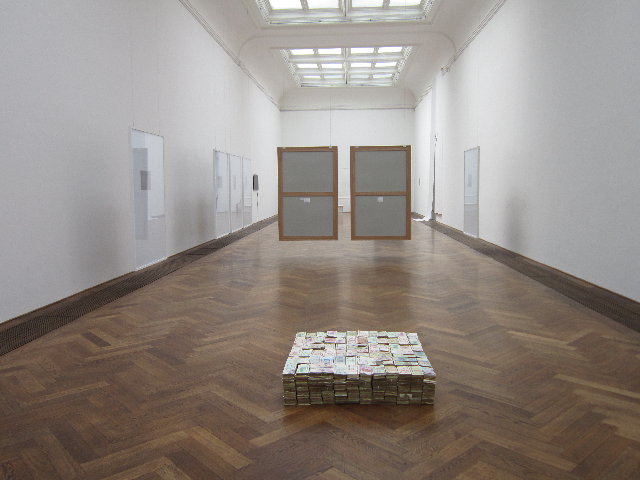
exhibition view


Pratchaya Phinthong, Pile of Zimbabwe Dollars, 2009

Tania Perez Cordova, 'Save your eyesight', film roll held under the sun, golden frames, 2011

Tania Perez Cordova, 'Save your eyesight', film roll held under the sun, golden frames, 2011

Adrian Melis, excuses of Cuban workers for not going to work, 2009

Tobias Kaspar, hanging c-prints, 2010

Tania Perez Cordova, 'Held shade (things come in and out of frame)', 2011

Pamela Rosenkranz, 'Death of Yves Klein', 2011


Juliette Blightman, 'Prelude to an Afternoon', pencil on paper, side table, lamp 2011

Adriana Lara, mini japanese garden digital print, 2011

Juliette Blightman, her mother lamp and plants brought from her mothers house, drawn on previous work, 2011


Adriana Lara, silver silkscreen advert posters for Contramar restaurant in Mexico City, 2011
(done maybe in exchange for free lunches...)

Tania Perez Cordova, 'Things Coming in and out of Frame', 2011
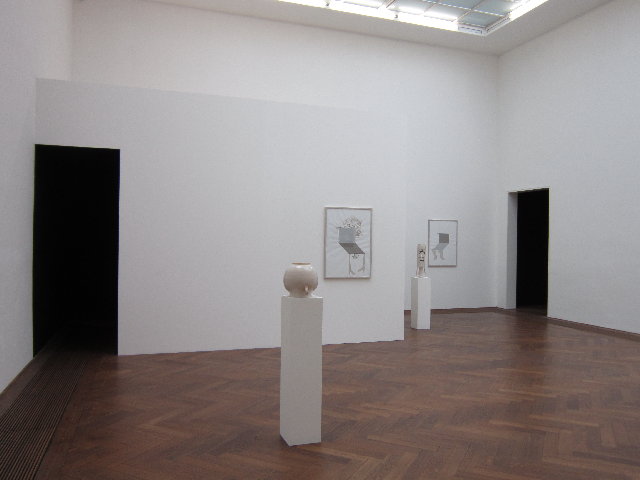

Judith Hopf, found pottery with faces, and drawings of laptops, 2011

Adriana Lara, ready made video, Venice city advert shown in art context, 2011

Tania Perez Cordova, dancing woman and palm tree silk screen, 2011

Prathchaya Phintong, Oil on canvas, plastic foil, 2011


Pamela Rosenkranz, makeup colours paint on spandex, 2011

Pamela Rosenkranz, 'Set of Materials to Express Your Self', inside fedex box, 2011

Pamela Rosenkranz painting and Adriana Lara video

Adirana Lara, 'Momentum', 2011
ready made video of silver balls in pendulum, shown in a flat screen with a black box built around it to give it a seventies conceptual aura

Adriana Lara, '(More For)', 2011


Prathchaya Phintong, one way division mirror, which allows visitors to the exhibition to see the kunsthalle's office space, without the kunsthalle workers being able to see the visitor. Here mirror seen from the office space


Fischli and Weiss, 'How To Work Better', c-print in the office space


How to Work (More for) Less
12 June–28 August 2011
Juliette Blightman, Tania Pérez Córdova, Raphael Hefti, Judith Hopf, Tobias Kaspar, Adriana Lara, Adrian Melis, Pratchaya Phinthong, Pamela Rosenkranz, Pilvi Takala & Projekt an der Rückwand / Back wall project: Pedro Wirz

The show has been developed as a series of modifications performed on the art works that constituted the previous group exhibition at Kunsthalle, which was entitled “How to Work”. In “How to Work”, we aimed at questioning all the different ways of working as an artist today. The exhibition brought together heterogeneous responses to the question of the basic motivations behind making art, the methods artists use, and the goals they want to achieve. The show investigated a range of contemporary modes of production, from the rhetorical elaboration of a typical studio practice to appropriation of existing cultural material or the blurring of boundaries between commercial and artistic work; from semi-clandestine, subversive operations in the public sphere to delegating work to a third party. These working methods and the strategies they represent can be traced back to several radical developments in 20th century art: the idea of questioning the exclusivity of artistic labor in Conceptual Art, the use of chance processes and found objects by Dadaists and Surrealists, but also Russian Productivism with its postulate of artistic work counting possibly as one of the types of non-alienated labor.

The idea was to continue working on the show that was already “there” and give it a new title: “How to Work Less”. This not only signals a productive interval in production; it also subverts the demand for absolute novelty that drives the majority of art exhibitions today and, at the same time, for shows whose premises and content are fully transparent, a commonly pursued objective in today’s contemporary exhibition operations. We hoped that by proposing to “work less” we could do more than that. One of the participating artists, Adriana Lara, points out that while emphasizing the declared wish to “work less”, the exhibition in fact requires substantial “brainwork” on the part of all participants (artists, curators, and audience alike) and ends up being more work intensive. In conclusion, Lara suggested a dialectic change of the title into “How to Work (More for) Less”, which was accepted as her contribution to the show.

Works seen in “How to Work” have been expanded, others rearranged, and still others shown in reduced form or even left out. Two more artists have been invited to “How to Work (More for) Less” who did not participate in “How to Work”: Judith Hopf and Pedro Wirz, with his special project of collaborative sculptural works for the back wall of the Kunsthalle.

As the constant increase of work efficiency, productivity, and profit is the core of capitalism, the refusal to work is an economic nightmare. The notion of “abandoning the workplace” or just “working less” critically addresses the distinction between work and leisure, which defines the capitalist organization of time. At the same time, taking a critical distance to work means more work—and this is what the artists in the show decided to do.

***
The Centre for the Aesthetic Revolution thanks Roos Gortzak at Kunsthalle Basel

Thursday, 4 August 2011

'CASA BARRAGAN FACE PAINTINGS' A PROJECT BY PAUL SAMMUT AND ALEXANDRA TERRY


"I thought about Barragan's house in Mexico City because it's composed of these bright flamboyant colours and grand vistas but is also about withdrawal and separation. It's so full of paranoia and hidden behind these stunning monochromes. The square was obviously based on Goeritz's gold paintings. I paired the palette down to white, gold and bright pink, like in Barragan's foyer space, to keep it simple..."
Paul Sammut

Conceived and developed by P.A.S.T. Projects (Paul Sammut and Alexandra Terry)
http://pastprojectslibrary.blogspot.com/

Wednesday, 3 August 2011

THOMAS GLASSFORD, HOME/STUDIO VISIT IN MEXICO CITY


view of Thomas Glassford's warehouse studio


fluorescent plant hanging in Thomas Glassford's studio


Thomas Glassford was born in 1963 in Laredo, Texas. He received his BFA from the University of Texas at Austin. In 1990, he moved to Mexico City. Glassford uses everyday materials to create architectural or installation-scale works. Having used diverse objects --from gourds and used broomsticks to mirrors and fluorescent light-- Glassford has most recently used anodized aluminum molded siding. Both decorative and alluring, these industrial materials are transformed into rhythmic images reminiscent of Minimalist sculpture, Op Art painting of the 1960s, as well as Mexican Baroque decorations of the XVIII century.

Selected solo exhibitions include: Xipe Totec, Centro Cultural Universitario Tlatelolco, UNAM, Mexico City, Mexico (2010); Afterglow, Museo Experimental El Eco, Mexico City, Mexico (2010); Cadaver Exquisito, el Museo Universitario de Ciencias y Artes (MUCA) UNAM (2006), La Torre de los Vientos, Mexico City DF (2001) and Museo de Arte Contemporáneo, Oaxaca (1996). Solo exhibitions include: Select group exhibitions include: Tlatelolco and The Localized Negotiation on of Future Imaginaries, Museum as Hub, New Museum, New York, New York (2008), Second Lives, Museum of Arts and Design, New York, New York (2008), Constructing a Poetic Universe: The Diane and Bruce Halle Collection of Latin American Art, The Museum of Fine Arts, Houston, Texas (2007), Los Angeles/Mexico Complejidades y Heterogenidad, La Colección Jumex, Mexico DF (2006), Made in Mexico, The Institute of Contemporary Art, Boston, Massachusetts, Hammer Museum, Los Angeles, California (2004), Mexico: Identidad y Ruptura, Fundación Teléfonica, Madrid, Spain (2003), La persistencia de la imagen, Museo de Arte Carrillo Gil, Mexico D.F. (2001), Cinco Continentes y una Ciudad, Museo de la Ciudad, Mexico (2000), InSite (1997, 2005), Havana Biennial (1994 and 1997. Select permanent collections include: Museum of Fine Arts, Houston, Texas; Televisa Collection, Mexico DF; Gelman Collection, Mexico DF; La Colección Jumex, Mexico; The Bruce and Diane Halle Collection, Phoenix, Arizona; Collezione “La Gaia,” Italy; Montblanc International Collection; CIFO Foundation, Miami, Florida; Jerry I Speyer Collection, New York, New York; Vergel Foundation, USA; Neeley Collection, USA; Associaçao Beneficente Alzira Denise Hertzog da Silva, Brazil; Colección Valdemarín, Madrid, Spain and Museo Extremeño e Iberoamericano de Arte Contemporáneo, Bajadoz, Spain.

Thomas Glassford lives and works in Mexico City, Mexico.

http://www.sicardi.com/artists/thomas-glassford/

Tuesday, 2 August 2011

MATHIEU COPELAND: 'STUDIES FOR A CATALOGUE: A STUDY FOR AN EXHIBITION OF VIOLENCE IN CONTEMPRARY ART (REFPRISE 1964/2011)' AT LATHAM'S FLAT TIME HOUSE


John Latham's Flat Time House in Peckham


Mr. Copeland and Mr. Bruggemann at Latham's brain, watching 'a study for an exhibition of violence in contemporary film'


Latham's study for Flat Time House facade


Panels of a Study for an Exhibition of Violence in Contemporary Art


catalogue for 'A Study for an Exhibition of Violence in Contemporary Art (Reprise 1964/2011)' available to download at http://www.reprise.me/


Stefan Bruggemann's contribution to the catalogue


PLB's contribution to the catalogue


and PLB as the BBQ man!


Reprise #1 - Studies for a catalogue / a study for an exhibition on violence in contemporary art (reprise 1964/2011)
Flat Time House, London - Friday 24 June - Sunday 31 July
Closing Bbq & Publication Launch - Sunday 31 July, 2-6pm

Reprise #1 - Studies for a Catalogue: a Study for an Exhibition of Violence in Contemporary Art (Reprise 1964/2011)

with Karel APPEL – Jean ARP – Francis BACON – Enrico BAJ – Elena BAJO – Giacomo BALLA – Davide BALULA – BALTHUS – Erica BAUM – Max BECKMANN – Tom BENSON – Hans BELLMER – George BELLOWS – Emma BJORNESPARR – Peter BLAKE – Umberto BOCCIONI – Frank BOWLING – Georges BRAQUE – Victor BRAUNER – Stefan BRÜGGEMANN – Edward BURRA – Alberto BURRI – Reg BUTLER – Alexander CALDER – Guiseppe CAPOGROSSI – Carlo CARRA – CESAR – Paul CEZANNE – Lynn CHADWICK – DADO – Salvador DALI – Alan DAVIE – Giorgio DE CHIRICO – Willem DE KOONING – Niki DE SAINT–PHALLE – Philippe DECRAUZAT – André DERAIN – Otto DIX – Jean DUBUFFET – Marcel DUCHAMP – James ENSOR – Max ERNST – Peter FILLINGHAM & Charlotte MOTH – Lucio FONTANA – Sam FRANCIS – Alberto GIACOMETTI – Juan GRIS – Arshile GORKY – Georg GROSZ – Renato GUTTUSO – Richard HAMILTON – Raoul HAUSMANN – Rudolph HAUSNER – John HEARTFIELD – Erich HECKEL – Anne-Sylvie HENCHOZ – Camille HENROT – Maurice HENRY – Roger HILTON – David HOCKNEY – Hans HOFMANN – Allen JONES – Asger JORN – Frida KAHLO DE RIVERA – Wassily KANDINSKY – Ellsworth KELLY – R.B. KITAJ – Paul KLEE – Oskar KOKOSCHKA – Alfred KUBIN – KUKRYNSKI – Felix LABISSE – Wilfredo LAM – John LATHAM – Fernand LEGER – Pablo LEON DE LA BARRA – Wyndham LEWIS – Roy LICHTENSTEIN – Max LINDNER – Jacques LIPSCHITZ – LUCEBERT – René MAGRITTE – André MASSON – Umberto MASTROIANNI – Georges MATHIEU – Henri MATISSE – Mark MCGOWAN – MATTA – F.E. McWILLIAM – Henri MICHAUX – Manolo MILLARES – Joan MIRO – Piet MONDRIAN – Henry MOORE – Edvard MÜNCH – Antonio MUSIC – R. MUTT (Marcel Duchamp) – Paul NASH – Warren NEIDICH – Sidney NOLAN – José Clemente OROZCO – Eduardo PAOLOZZI – Peter PHILLIPS – Francis PICABIA – Pablo PICASSO – Edouard PIGNON – John PIPER – Philomene PIRECKI – Jackson POLLOCK – POSADA – Mel RAMOS – Man RAY – Odilon REDON – RICHARDS – Germaine RICHIER – Bridget RILEY – Diego RIVERA – RODIN – Theodore ROSZAK – Georges ROUAULT – Henri ROUSSEAU – Antonio SAURA – Giorgio SADOTTI – Gerald SCARFE – Karl SCHMIDT–ROTLUFF – SCHROEDER-SONNENSTERN – Kurt SCHWITTERS – Gino SEVERINI – Ben SHAHN – SINE – David Alfaro – SIQUEIROS – Richard SMITH – Chaim SOUTINE – Saul STEINBERG – Graham SUTHERLAND – Rufino TAMAYO – Yves TANGUY – Dorothea TANNING – Jean TINGUELY – Henri de TOULOUSE-LAUTREC – Clovis TROUILLE – Fritz VAN DEM BERGHE – Victor Vincent VAN GOGH – VASARELY – Renzo VESPIGNANI – Andy WARHOL – Neal WHITE – WOLS and Ossip ZADKINE.
An Exhibition by Mathieu COPELAND.

"I am calling this a 'Study' for an exhibition of Violence in Contemporary Art so as to be able to include reproductions and design it so that it can travel to the Provinces when it closes here at the end of March."
Roland Penrose in a letter to the Hon. David L Astor.

Over the winter of 1963 Roland Penrose and his colleagues at the ICA were busy planning A Study for an Exhibition of Violence in Contemporary Art, “an anthology of the various ways in which Violence appears in art”. The exhibition was primarily made up of photographic representations of works, categorised and mounted on thematic panels. The accompanying events programme was an attempt at a similarly exhaustive investigation of violence in the other art forms (film, poetry, theatre, music) and in society more generally. The three-month programme included events as diverse as screenings of Jean Rouch’s films of the traditions and culture of the Niger River valley; films of Francis Bacon, Jackson Pollock and Karel Appel at work under the collective title ‘Films of Action and Violence in Painting’; R.D. Laing speaking on ‘Violence and Love’; Dr Hans Keller on ‘Musical Sadism’; Dr Alex Comfort on ‘Hokum and the Ancestry of the Novel’; and Desmond Morris on ‘Sex and Aggression in Animals’.

In a letter to Dominique de Menil, a patron of the exhibition, Penrose wrote that the ICA hoped to publish a collection of “the most important lectures, and radio and T.V. will, we believe, do their part. What we hope is that we can make this programme so important that it will start up other discussions and provoke a general interest with a view to shedding more light on this trouble-maker, violence.” There was some discussion with Penguin about the publication of a volume of papers drawn from the events programme, but as far as we can tell, this did not happen. An special edition of the BBC arts magazine programme, Monitor, was broadcast in 1964. But the only known publication to accompany the exhibition was a slim volume with a foreword by Penrose and a list of works, original and in reproduction. It’s cover was illustrated with an image of Lucio Fontana at work.

The exhibition at Flat Time House of curator Mathieu Copeland’s ‘bootleg’ of the ICA show, and the very lack of an extensive catalogue of the original show, prompted this publication, Study for a Catalogue. It is an imagined version of what that catalogue might have been; and also of what the exhibition might be, if curated anew in 2011. It comprises photocopied reproductions of all the works from the show (with some free replacements where works were not identifiable from the original catalogue, or have not been readily available in reproduction); a text on the violence of curation by artist Warren Neidich; a downloadable screening programme, again liberally expanded from events that took place in 1964; and pages specially produced for the catalogue in the summer of 2011 by artists including Elena Bajo, Neal White, Davide Ballula, Erica Baum, Tom Benson, Emma Bjornesparr, Stefan Brüggemann, Philippe Decrauzat, Peter Fillingham & Charlotte Moth, Mark McGowan, Anne-Sylvie Henchoz, Pablo Leon de la Barra, Warren Neidich, Philomene Pirecki, and Giorgio Sadotti.

The catalogue, in B&W and A4 format, can be downloaded from http://www.flattimeho.org.uk or http://www.reprise.me ready to be printed. A page template will be freely available so that new pages and chapters can be added with the intention that these Studies for both an Exhibition and a Catalogue of Violence in Contemporary Art can extend the debate, begun in 1964, about the good and bad in violence and about the very image of violence itself.

Text by Elisa Kay
27 July 2011

http://www.mathieucopeland.net/